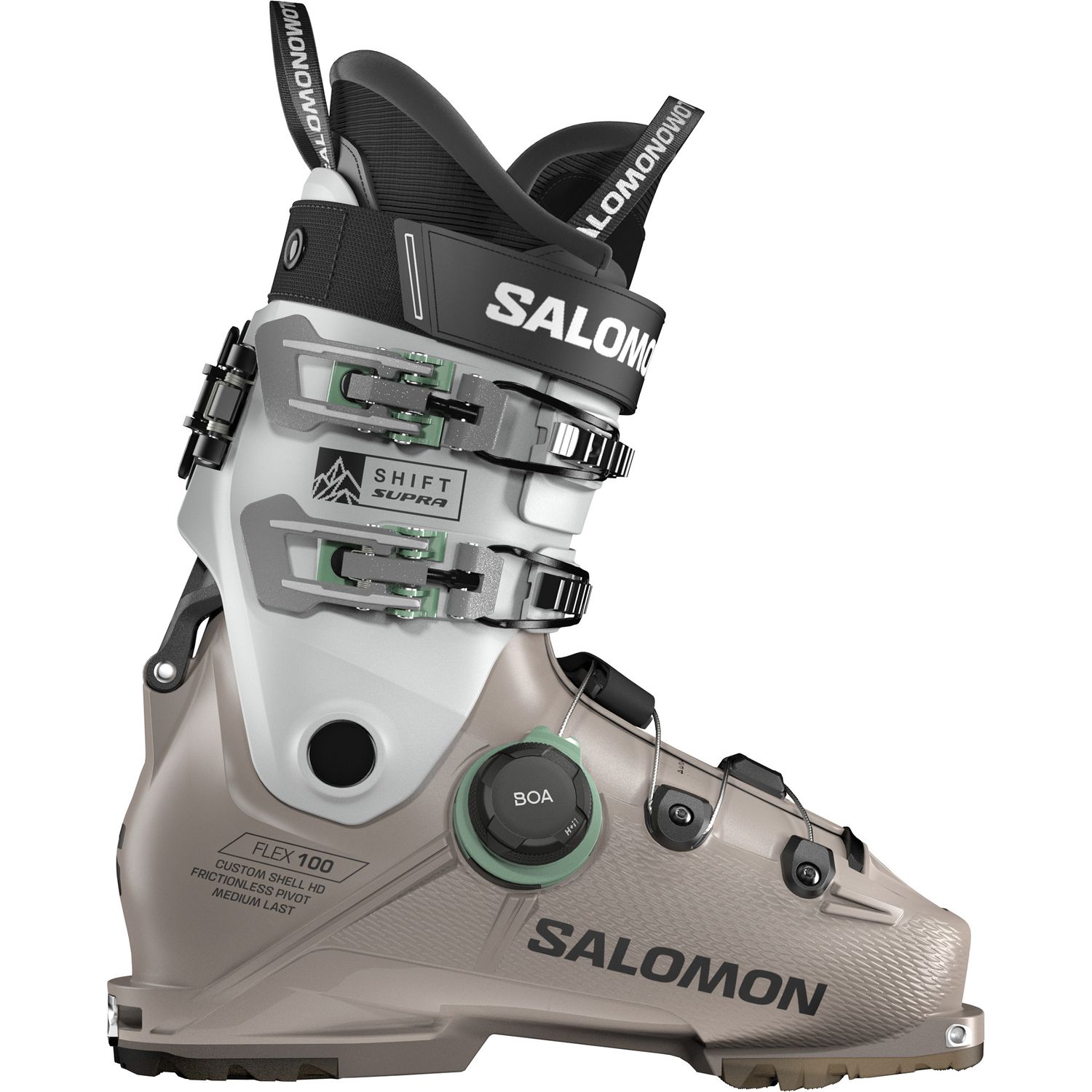
Perfect for freeriders who value comfort and simplicity, Salomon's Shift Supra BOA® 100 boots provide enhanced comfort and dependable performance on every ride. Featuring the BOA® Fit System and Exobelt™ Technology, these boots ensure a secure and supportive fit, making them ideal for exploring the mountain at your own pace.
The inclusive 100mm last wraps your foot perfectly, enhancing your connection to the ski for precise control on varied terrain, whether skinning up or charging down.
The TwinLock Mechanism offers unparalleled mobility and a wide range of motion during ascents without sacrificing the power and stability needed for aggressive descents.
Equipped with Exobelt™ Technology and a dialed-in Boa® Fit System, this boot ensures the heel retention, power transfer, and control needed for secure, high-speed turns.
Flex Index
- Flex Index is how much effort or work is required to move the cuff of the ski boot forward while the lower shell is stationary; typically retained by the binding. This number can be anything from 50 or 60 to 130+ (or even 1 - 10). There is no standard for this number across the ski boot industry and the ‘Flex Index’ is not based on any metric like newton-meters, foot-pounds, or Pascals. Even within any given manufacture’s line-up, a boot with a Flex Index of 110 might not be the same as another boot with the same rating. The main thing to remember is that the higher the number, the stiffer the boot. The Flex Index should only be used as just one general factor in choosing a ski boot.
- Your style of skiing, experience, level of skiing, terrain, use, height, mass, and personal preference all play a role in helping you pick the stiffness of your boot. A World Cup racer or an advanced/expert skier that prefers making precision turns at high speeds requiring techniques using a lot of tip pressure might need a stiffer boot. On the other hand, someone who hits the slopes every weekend with her family or Patrols three days a week might prefer a more moderate flex.
Last
- ‘Last’ is a metric that describes the width of your foot at its widest point, which is typically at the forefoot or the ball of your foot. This will be represented in millimeters: i.e: 102mm. This is a critical consideration, because going up a size in a boot will move the widest part of the boot forward while the widest part of your foot will be kept reward. As you can gather, going up a size is not an option.
*For a comprehensive explanation on ski boot fitment, please visit the link below:
Ski Boot Fitment
Alpine
- Our Alpine ski boots are designed for maximum control and performance for downhill alpine skiing. These boots will be not be optimal for touring/skinning as the cuff is typically fixed, keeping you in a natural ski position. These boots are designed to work with any Alpine DIN binding. Alpine DIN bindings must be installed, adjusted, and function tested by a certified binding technician.
Alpine Touring, A/T, or Randonnée
- Our Touring boots will typically be made with lighter materials. They will also generally have a ‘Walk’ mode in the rear of the boot, allowing the cuff to release for a greater range and ease of motion. Our Touring boots will be compatible with bindings designed for Alpine Touring (A/T) and equipped with ‘Tech’ Inserts. Also, permitting the boots are equipped with Alpine or Grip Walk soles, they will be compatible with most contemporary Alpine DIN Bindings. Both A/T bindings and Alpine DIN bindings must be installed, adjusted, and function tested by a certified binding technician.
*If you’re unsure if your boots and bindings are compatible, please have a qualified technician give them a tactile and visual inspection.